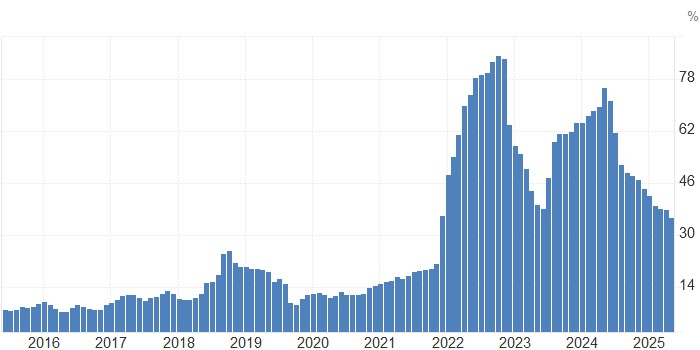
The concept of the “crack-up boom” originates from Ludwig von Mises, one of the central figures of the Austrian School of economics. While often misunderstood as a period of prosperity, Mises used the term to describe a terminal phase of monetary disorder—an environment where confidence in currency collapses and economic behavior becomes dominated by the urgency to exchange money for real assets.
The Theory: From Inflation to Currency Flight
Mises’ crack-up boom (German: Katastrophenhausse) emerges not at the beginning of inflationary policy, but at its culmination.
The mechanism unfolds in stages:
1. Monetary Expansion
Central banks increase the money supply—often to stimulate growth, finance deficits, or stabilize financial systems. Initially, this creates the appearance of prosperity: asset prices rise, credit expands, and consumption increases.
2. Price Inflation and Distortions
As new money enters the system unevenly, it distorts relative prices, encourages malinvestment, and erodes purchasing power. At this stage, inflation is often still perceived as manageable or even beneficial.
3. Rising Inflation Expectations
Eventually, economic actors begin to anticipate continued inflation. This is the inflection point: behavior changes. Instead of holding cash or fixed-income instruments, investors and consumers accelerate purchases.
4. The Crack-Up Boom
In the final phase, confidence in the currency itself deteriorates. Money is no longer viewed as a store of value. Individuals and institutions rush to convert cash into tangible assets—real estate, commodities, equities, or even durable goods—not necessarily because they are fundamentally attractive, but because they are preferable to holding depreciating currency.
This is not a boom in the traditional sense. It is a flight from money.
Are We Seeing the Preconditions Today?
The question of whether current monetary conditions could lead to a crack-up boom is contentious—but worth examining.
In the years following major crises (e.g., the Global Financial Crisis and the COVID-era response), central banks dramatically expanded balance sheets. Measures such as quantitative easing, fiscal monetization, and prolonged low interest rates have led to:
- Sustained growth in broad money aggregates
- Elevated asset valuations across equities, real estate, and alternative assets
- Increased sensitivity of markets to liquidity conditions
However, a true crack-up boom requires more than monetary expansion alone. The critical variable is confidence.
So far, in most developed economies:
- Inflation expectations, while volatile, remain partially anchored
- Fiat currencies are still widely trusted as units of account and mediums of exchange
- Policymakers retain at least some credibility in managing inflation
That said, certain warning signs occasionally surface:
- Sudden surges in demand for hard assets (e.g., gold, energy, land)
- Retail speculation driven by fear of currency debasement rather than fundamentals
- Persistent negative real interest rates
- Fiscal dominance, where monetary policy effectively serves government financing needs
While these conditions do not guarantee a crack-up boom, they align with earlier stages of Mises’ framework.
Portfolio Implications: Positioning for Monetary Instability
For an experienced investor, the crack-up boom is not a prediction to trade directly, but a risk framework to prepare against.
1. Reduce Exposure to Monetary Assets
Cash and long-duration fixed-income securities are most vulnerable in a currency confidence crisis. While liquidity is essential, excessive allocation to nominal assets carries asymmetric downside in high-inflation regimes.
2. Favor Real Assets
Assets with intrinsic or utility value tend to outperform during periods of currency debasement:
- Commodities (especially energy and industrial inputs)
- Precious metals
- Real estate with pricing power
- Infrastructure assets with inflation-linked revenues
3. Equity Selection Matters More Than Equity Exposure
Equities as a class can provide partial inflation protection, but outcomes diverge significantly:
- Favor firms with strong pricing power, low capital intensity, and real asset backing
- Avoid businesses dependent on cheap financing or long-duration cash flows
4. Geographic Diversification
Currency crises are often localized before they become systemic. Diversifying across jurisdictions with differing fiscal and monetary profiles can reduce concentrated risk.
5. Optionality and Convexity
Maintaining exposure to asymmetric opportunities—whether through commodities, volatility strategies, or niche assets—can provide upside in disorderly transitions.
A Final Perspective
Mises’ crack-up boom is ultimately a theory about human behavior under monetary stress. It is less about the precise level of money supply and more about the moment when collective belief in money falters.
That moment is difficult to predict—and even harder to time. But for disciplined investors, the lesson is clear:
monetary stability should never be taken for granted, and portfolios should be robust to its absence.